Pakistan Budget 2026-27: Latest Updates, Expected Measures, Tax Targets and Economic Outlook
Pakistan Budget 2026-27 is one of the most important financial events for the country because it will decide the direction of taxes, salaries, development spending, inflation control, business policy, and public relief for the next fiscal year. The federal is expected to come at a time when Pakistan is trying to maintain economic stability, meet IMF conditions, increase revenue, support growth, and reduce pressure on ordinary citizens.
According to the latest reported updates, the Pakistan federal for FY2026-27 is expected to focus on revenue collection, fiscal discipline, economic growth, public sector development, and targeted relief. The government is likely to present the with a careful balance between IMF requirements and public expectations. People are waiting to see whether the budget will bring relief in income tax, salary increases, pension adjustments, development spending, or new taxes.
Pakistan Budget 2026-27 Expected Date
The Pakistan 2026-27 is expected to be presented in early June 2026. Reports suggest that the National Assembly and Senate sessions have been summoned for the process. The final official details will be confirmed when the finance minister presents the speech in parliament.
This is especially important because Pakistan is currently working under a strict economic reform environment. The government needs to increase tax revenue, control the fiscal deficit, manage debt payments, and continue reforms to keep the economy stable.
Expected Size of Pakistan Budget 2026-27
The total size of the federal budget is expected to be around Rs17 trillion to Rs18 trillion. Different reports suggest that the proposed volume may cross Rs17.1 trillion and could be closer to Rs17.8 trillion. The exact number will be confirmed after the official announcement.
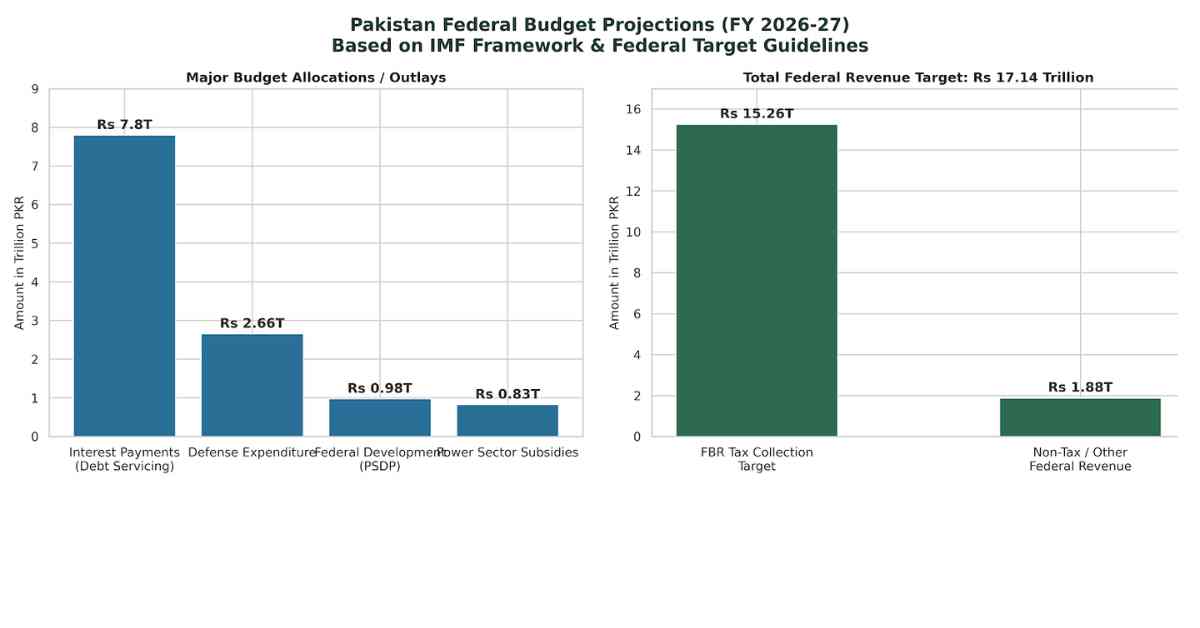
A large part of the budget will likely go toward debt servicing, defence, subsidies, pensions, development projects, and government expenses. Debt servicing remains one of the biggest challenges for Pakistan because a huge portion of federal revenue is used to pay interest on loans.
Economic Growth Target
The government is expected to set the GDP growth target at around 4.1% for FY2026-27. This target shows that Pakistan wants to move from stabilization toward growth. However, achieving this target will depend on many factors, including agriculture output, industrial production, exports, remittances, inflation, energy prices, and political stability.
For ordinary people, economic growth matters because it can create jobs, improve business activity, and increase investment. But growth will only benefit the public if inflation remains under control and wages improve.
Inflation Outlook
The expected inflation estimate for the upcoming fiscal year is around 8.4%. This is lower than the extremely high inflation Pakistan faced in previous years, but prices are still a major concern for households. Food, electricity, fuel, rent, school fees, transport, and healthcare expenses continue to affect middle-class and lower-income families.
This may include targeted relief measures, but broad subsidies are difficult because of fiscal pressure and IMF-related conditions. The government may focus more on targeted support instead of general subsidies.
One of the most important parts of Pakistan 2026-27 will be the tax target. The government is expected to set an ambitious revenue target to meet fiscal requirements. Reports suggest that the tax and revenue targets may be significantly higher than the previous year.
This means the government may focus on expanding the tax net, reducing tax evasion, increasing documentation, and improving digital tax systems. Instead of only increasing tax rates on existing taxpayers, Pakistan needs to bring more untaxed sectors into the tax system.
Salaried individuals, businesses, retailers, real estate investors, importers, exporters, and digital earners may all closely watch the budget because changes in tax rules can directly affect their income and expenses.
Possible Income Tax Relief
There are expectations that the government may consider some income tax relief for salaried individuals, especially lower and middle-income groups. Salaried people have been demanding relief because inflation and tax deductions have reduced their take-home income.
However, any relief will depend on the fiscal space available to the government. If income tax rates are reduced, the government may need to recover revenue from other sectors or improve tax compliance.
Salary and Pension Expectations
Government employees are also waiting for salary and pension announcements. In every budget, salary increase and pension increase are among the most searched topics. Reports suggest that salary and pension decisions will be influenced by IMF conditions and the government’s financial space.
If the government gives a major salary increase, it will increase expenditure. If it does not give enough relief, employees may face more pressure from inflation. Therefore, the government may choose a moderate increase or targeted relief.
Development Spending and PSDP
The Public Sector Development Programme is expected to remain an important part of the budget. Development spending helps fund infrastructure, roads, energy projects, education, health, water, technology, and regional development.
However, Pakistan often faces a challenge where development spending is reduced or delayed because of debt payments and current expenditures. For long-term economic growth, Pakistan needs productive development projects that create jobs and improve exports.
Defence Budget
The defence budget is always an important part of Pakistan’s federal budget. Due to regional security challenges, defence spending remains a priority. However, the government also has to balance defence needs with education, healthcare, infrastructure, and social protection.
A responsible budget should protect national security while also supporting human development and economic growth.
IMF Conditions and Pakistan Budget
Pakistan’s budget is strongly connected with IMF requirements. The IMF usually focuses on increasing revenue, reducing fiscal deficit, controlling subsidies, improving energy sector reforms, and strengthening economic governance.
This means Pakistan Budget 2026-27 may not be a fully relief-based budget. It may be a reform-focused budget where the government tries to satisfy international lenders while giving limited relief to the public.
Impact on Common People
For the common people, the most important questions are simple: Will prices go down? Will salaries increase? Will taxes decrease? Will electricity and fuel become cheaper?
The answer depends on the final budget measures. If the government controls inflation, gives tax relief, supports employment, and avoids unnecessary indirect taxes, the budget can help citizens. But if new taxes increase the prices of daily-use items, the public may feel more pressure.
Impact on Businesses
Businesses want tax stability, lower cost of doing business, cheaper energy, easier imports of raw material, export support, and simple documentation. If the budget supports industries, SMEs, freelancers, IT exports, agriculture, and manufacturing, it can improve economic activity.
Pakistan needs a business-friendly budget that encourages investment instead of discouraging formal businesses with complicated taxes.
Digital Economy and IT Sector
The IT sector is one of Pakistan’s strongest growth opportunities. Budget 2026-27 should support freelancers, software houses, startups, e-commerce businesses, and digital exporters. Clear tax rules, stable policies, and export incentives can help Pakistan increase foreign exchange earnings.
If the government supports the digital economy, Pakistan can create jobs for young people and reduce pressure on traditional sectors.
Agriculture and Food Security
Agriculture is the backbone of Pakistan’s economy. The budget should focus on farmers, seeds, fertilizers, water management, modern farming, crop insurance, and agricultural technology. Better agriculture policies can reduce food inflation and improve rural incomes.
If farmers get support, the whole economy benefits because agriculture is directly linked with food prices, exports, and employment.
Budget Graph :
FAQs About Pakistan Budget 2026-27
1. When will Pakistan Budget 2026-27 be announced?
Pakistan Budget 2026-27 is expected to be announced in early June 2026. The final date will be confirmed through official parliamentary proceedings and the finance ministry.
2. What is the expected size of Pakistan Budget 2026-27?
The expected federal budget size is reported to be around Rs17 trillion to Rs18 trillion. The final figure will be confirmed after the official speech.
3. Will salaries increase in Pakistan Budget 2026-27?
Government employees are expecting a salary increase, but the final decision depends on the government’s fiscal space and IMF-related conditions.
4. Will pensions increase in Budget 2026-27?
Pensioners are also expecting relief. However, the official pension increase will only be confirmed after the announcement.
5. What is the expected GDP growth target for Pakistan in FY2026-27?
The expected GDP growth target is around 4.1%, according to recent reports.
6. Will income tax decrease for salaried people?
There are expectations of possible income tax relief for salaried individuals, especially lower and middle-income groups. Final details will be announced in the official .
7. Why is the IMF important in Pakistan’s budget?
The IMF is important because Pakistan is working under an economic reform program. IMF conditions influence tax targets, subsidies, spending, and fiscal discipline.
8. How will the budget affect common people?
This can affect common people through taxes, fuel prices, electricity costs, salary increases, inflation, subsidies, and development spending.
9. Will the budget increase prices?
If the government introduces new indirect taxes or increases levies, some prices may rise. However, if inflation remains controlled and relief measures are introduced, the pressure may be reduced.
10. What should people watch in Pakistan Budget 2026-27?
People should watch income tax changes, salary and pension increases, fuel levy, electricity subsidies, development spending, business taxes, and inflation targets.
Final Thoughts
Pakistan Budget 2026-27 is expected to be a difficult but important . The government has to balance public relief, IMF conditions, revenue targets, development spending, and economic growth. People want relief from inflation and taxes, while the government needs more revenue to manage debt and expenses.
The success of this budget will depend not only on announcements but also on implementation. Pakistan needs a that is realistic, transparent, growth-focused, and fair for all citizens. If the government expands the tax net, supports businesses, protects low-income families, and invests in productive sectors, Budget 2026-27 can become a step toward long-term economic stability.